
Your sleep study came back. The diagnosis is obstructive sleep apnea, and the standard recommendation is a CPAP machine. Maybe you have already tried one and struggled with it. Maybe you have not started yet and you are already dreading the mask, the hose, and the noise. Either way, you are asking the same question most patients ask: is there something that actually works just as well, without all of that?
The honest answer is: it depends on how you define “works.”
That is not a dodge. It is the most useful thing anyone can tell you before you make this decision. Clinical trials measure one kind of effectiveness. Real-world outcomes measure another. For oral appliance vs CPAP, those two measurements tell genuinely different stories, and understanding both is what helps you choose the right treatment.
A Side-by-Side Look
| CPAP | Oral Appliance | |
| How it works | Delivers pressurized air through a mask to hold the airway open | Advances the lower jaw slightly forward, keeping the airway open mechanically |
| AHI reduction (controlled settings) | Greater reduction in apnea-hypopnea index across studies | Meaningful reduction, but consistently lower than CPAP in controlled trials |
| Real-world adherence | Significant dropout; French national data shows 47.7% termination at three years | Generally higher; patients wear it more consistently |
| Portability | Requires machine, power source, distilled water | Small, lightweight, no electricity needed |
| Noise | Motor noise affects some bed partners | Silent |
| Best for | Severe OSA; patients who tolerate it well | Mild to moderate OSA; CPAP-intolerant patients; frequent travelers |
| Cardiovascular outcomes | Established evidence base | CRESCENT trial (JACC, 2024) found MAD noninferior to CPAP for blood pressure reduction in a specific high-risk population |
What “Effective” Actually Means

Clinical trials are designed to measure what a treatment does under ideal conditions. Patients are monitored, adherence is tracked, and the results reflect the therapy working as intended. By that measure, CPAP has a real advantage.
But a treatment only works when it is used. A machine that sits on the nightstand because the mask is uncomfortable, the noise keeps a partner awake, or the forced air feels suffocating is not treating anything. In a nationwide French cohort of approximately 480,000 CPAP users, overall termination rates reached 47.7% at three years (Bailly et al., ALASKA database, PMC). That is French national data, not a universal figure, but the pattern it reflects is consistent with what clinicians see in practice.
Real-world effectiveness is efficacy multiplied by how often the patient actually uses the treatment. That calculation changes the comparison considerably.
Where CPAP Has the Edge
On raw apnea reduction, CPAP wins. A 2025 umbrella review published in JBI Evidence Synthesis synthesized 27 systematic reviews and found that “all systematic reviews that compared oral appliances with CPAP consistently reported that CPAP was more efficacious, evidenced by a decrease in the apnea-hypopnea index, respiratory arousal index, and improved minimum oxygen saturation levels.”
The apnea-hypopnea index (AHI) measures how many times per hour breathing is disrupted during sleep. The respiratory arousal index tracks how often those disruptions cause the brain to partially wake. Minimum oxygen saturation captures how low blood oxygen drops during the night. On all three of these controlled-setting measures, CPAP outperforms oral appliances consistently across the research.
That is worth saying plainly. Oral appliance therapy is not a superior treatment for raw apnea suppression. What it offers is something different.
Where Oral Appliances Close the Gap
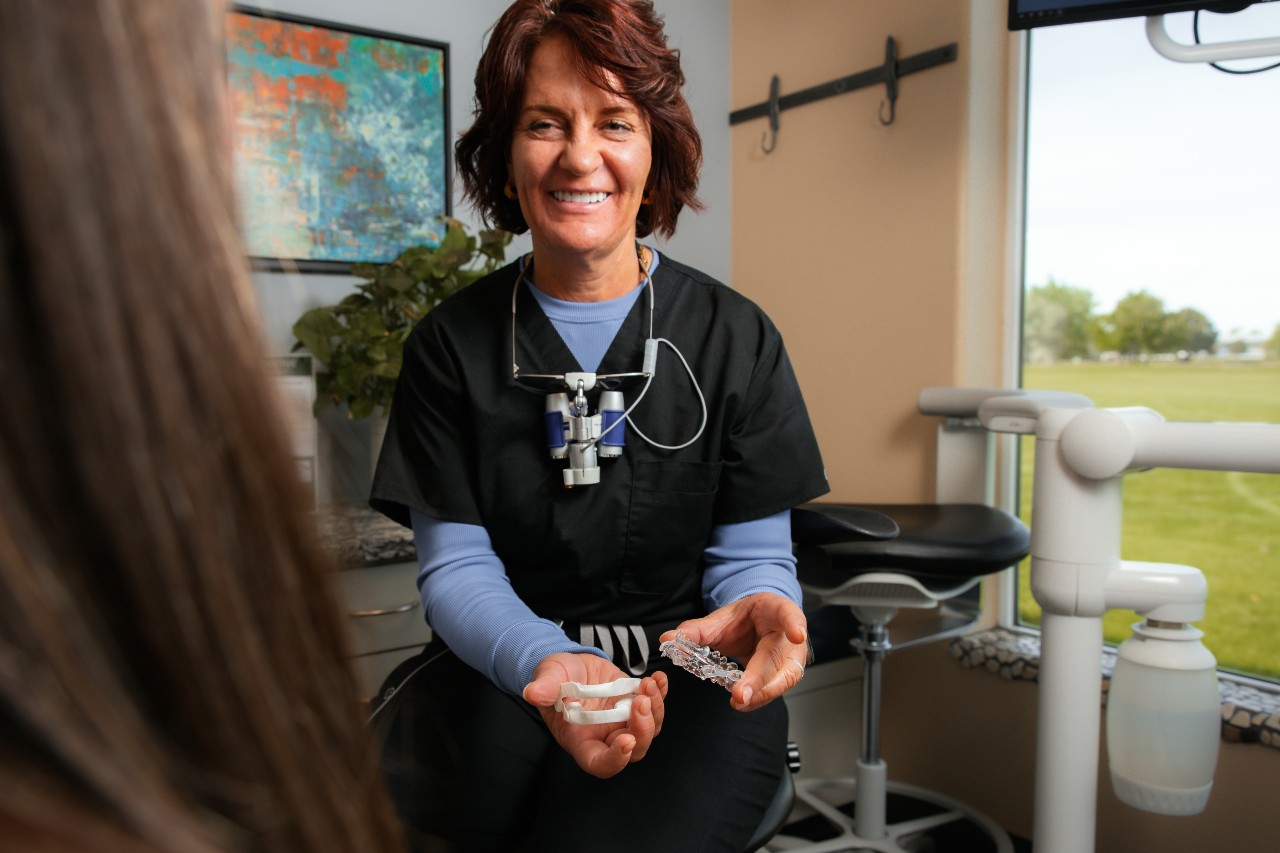
The same umbrella review that gave CPAP the edge on controlled efficacy also noted this: “While CPAP shows greater efficacy under controlled conditions, the real-world effectiveness might vary due to patient adherence. Patient preference appears to favour oral appliances over CPAP, potentially leading to greater patient satisfaction, better adherence, and longer treatment duration with oral appliances. This higher adherence could mean that oral appliances might achieve comparable or even superior overall clinical effectiveness compared to CPAP in practice.”
That finding has real-world support. The FLOSAT study, published in the American Journal of Respiratory and Critical Care Medicine in July 2026, measured something called mean disease alleviation (MDA), a composite that combines how well a treatment reduces apnea events with how consistently patients actually use it. In 94 patients with moderate-to-severe OSA, MDA was 49.9% with oral appliance therapy and 49.1% with CPAP. Nightly adherence was 6.7 hours with the oral appliance versus 5.4 hours with CPAP. The study’s authors concluded that MAD therapy achieved good efficacy and high adherence, resulting in non-inferior effectiveness compared to CPAP. They also noted that the sequential, non-randomized design limits interpretation and that the composite measure has not yet been validated against patient-important outcomes, so this should not be read as definitive proof of equivalence. It is, however, a meaningful signal.
On cardiovascular outcomes, the picture is also shifting. The CRESCENT trial, published in the Journal of the American College of Cardiology in 2024, randomized 220 patients with moderate-to-severe OSA, hypertension, and elevated cardiovascular risk to either a mandibular advancement device or CPAP for six months. The MAD group saw a 2.5 mm Hg reduction in 24-hour mean arterial blood pressure. No significant change was observed in the CPAP group. MAD was found noninferior to CPAP on this measure. This was a specific population with hypertension and elevated cardiovascular risk, not a general OSA sample, but the finding adds meaningful weight to the case for oral appliance therapy in patients where blood pressure management matters.
Beyond the data, the practical advantages are real. No mask. No motor noise. No hunting for distilled water in a hotel room. Patients sleep in any position they want. Their bed partners sleep undisturbed. The device fits in a carry-on without a second thought.
Who Is a Good Candidate?
Oral appliances are primarily indicated for mild to moderate OSA. Patients who cannot tolerate CPAP, whether because of claustrophobia, skin irritation, dryness, or simply the disruption to sleep, are strong candidates. So are patients with positional apnea, frequent travelers, and anyone whose lifestyle makes a machine genuinely impractical.
Severe OSA is a different situation. Some patients with severe OSA may still need CPAP, or a combination approach, and the right answer depends on a proper evaluation of your sleep study data, your airway anatomy, and your specific risk factors. An honest evaluation will tell you which category you fall into.
What the Evaluation Process Looks Like at Breathe While You Sleep

Getting a custom oral appliance is not a one-appointment process, and it should not be. At Breathe While You Sleep, the evaluation process follows five steps.
The first is an initial evaluation: a review of your sleep study data, an examination of your upper airway, and an assessment of your teeth and jaw joints. From there, highly accurate digital impressions are taken. Those impressions, along with data about your breathing patterns and risk factors, go to a specialized laboratory where your custom device is fabricated. Once it arrives, the device is fitted and fine-tuned, with gradual jaw advancement adjusted over time for both comfort and airway opening. The final step is follow-up care, including a home sleep test to confirm the device is doing its job.
That last step matters. A custom oral appliance is a medical device managing a medical condition. Confirming it works is part of the process, not an afterthought.
Is an Oral Appliance Right for You?
The question at the top of this article does not have a single answer. For raw apnea suppression in a controlled setting, CPAP has the edge. For patients who actually wear their treatment consistently, sleep comfortably, and sustain it over years, oral appliance therapy holds up well, and the research increasingly supports that.
For the right patient, a custom oral appliance is not a compromise. It is a clinically supported treatment that many people find more sustainable, more comfortable, and easier to live with long-term.
The only way to know whether you are that patient is a proper evaluation. Contact Breathe While You Sleep to schedule a comprehensive consultation and find out whether oral appliance therapy is the right fit for your diagnosis, your anatomy, and your life.

